












Table of Contents
You’ve bought the gold and silver — or you’re about to. Now the question every bullion buyer has to answer: where do you keep it? Learning how to store gold and silver safely matters as much as choosing what to buy. Precious metals are compact, valuable, and anonymous — qualities that attract thieves as well as investors. A good storage plan protects against theft, fire, and the quiet risks most people miss: insurance gaps and access problems. This guide walks through the three main options — home storage, bank safe deposit boxes, and private vaults — with honest pros, cons, and costs for each.
The Short Answer: How to Store Gold and Silver
When deciding how to store gold and silver, the safest method depends on how much you own. For modest holdings, a bolted-down, UL-rated home safe with a scheduled insurance rider works well. For larger amounts, a bank safe deposit box or — better yet — an insured private depository offers stronger protection. Whatever you choose, keep it secret, keep records, and never rely on FDIC insurance, which does not cover safe deposit box contents.
Option 1: Store Your Metals at Home
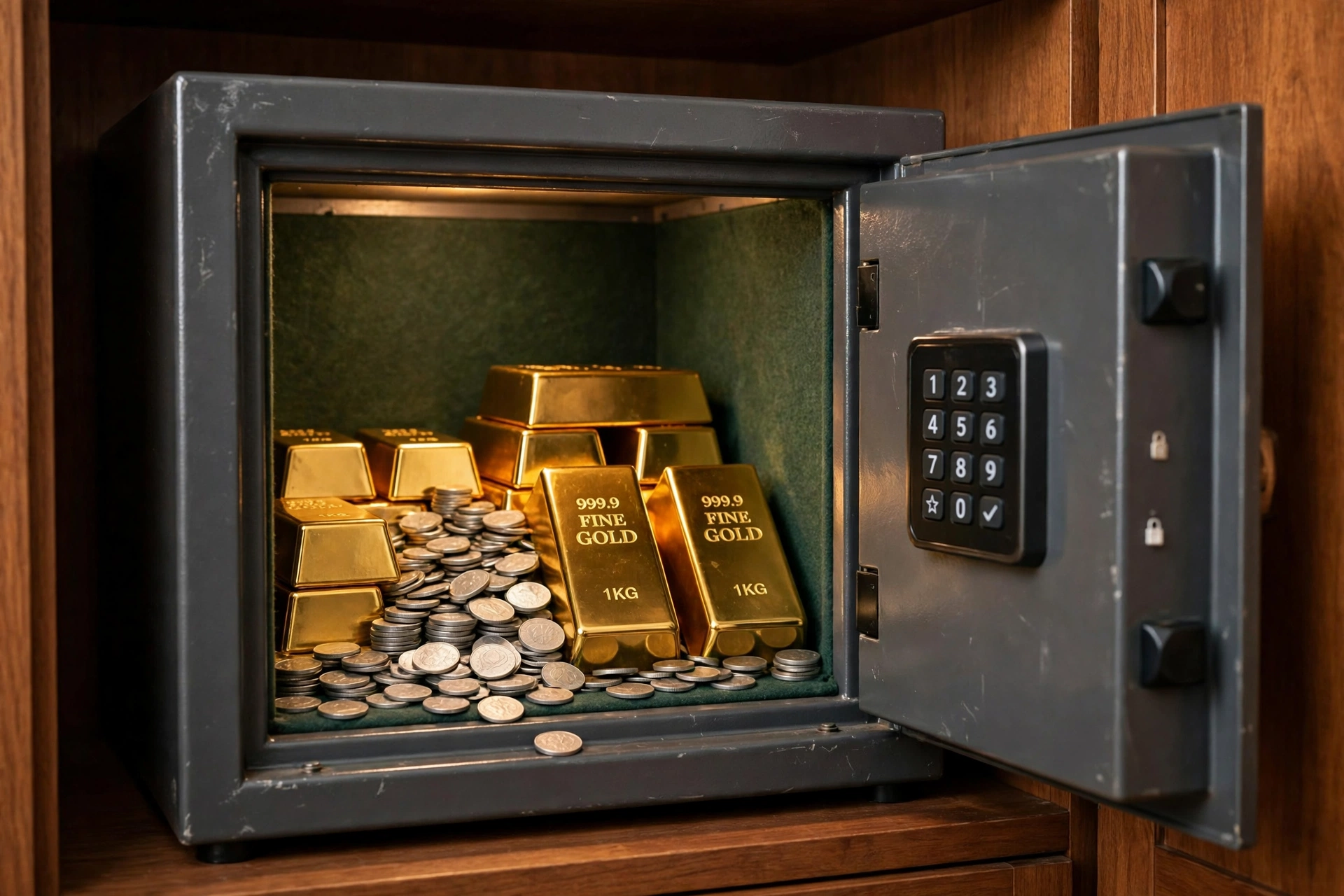
If you’re learning how to store gold and silver at home, home storage is the most popular choice — free, private, with 24/7 access. The catch: security is entirely on you.
Choose the Right Safe
Look for UL ratings: UL RSC (entry-level), UL TL-15 (the sweet spot for contents worth roughly $100k–$200k), or UL TL-30 (larger holdings). Bolt it down to concrete or a structural wall, and put it somewhere discreet — not the master bedroom closet.
Where NOT to Keep Gold and Silver
- Don’t bury it in the backyard.
- Don’t use “clever” hiding spots like the freezer or a hollowed-out book.
- Don’t store gold and silver in direct contact — silver tarnishes and can affect metals it touches.
- Handle coins with gloves; keep bars in their sealed assay packaging.
Haven’t bought yet? Read our complete guide on how to buy gold.
Option 2: Bank Safe Deposit Box
The FDIC Myth
The FDIC does not insure the contents of safe deposit boxes — the single biggest misconception in precious metals storage. The FDIC covers deposit accounts (checking, savings, CDs) up to $250,000. A box is rented storage, not a deposit account. (See the FDIC rules on safe deposit box insurance.)
Pros:
- Strong physical security
- Low cost: $50–$300 per year
- Off-site from your home
Cons:
- No FDIC insurance on contents
- Bank-hours access only
- Limited privacy
- Not waterproof or fireproof
- Some banks are phasing out boxes
Bottom line: a solid mid-tier option for metals you don’t need quickly — but budget for separate insurance.
Option 3: Private Vault or Depository
For those learning how to store gold and silver at the highest security level, the professional-grade option is purpose-built facilities with armed security, 24/7 monitoring, third-party audits, and insurance included. Examples include Delaware Depository (Wilmington, DE), Brink’s Global Services, International Depository Services (Dallas, TX and Delaware), and Loomis International. (See this depository vault explainer.)
Allocated vs. Segregated vs. Unallocated
- Segregated: your exact bars, held separately and serial-numbered.
- Allocated: metal assigned to you 1:1, though it may sit alongside other customers’ metal.
- Unallocated: a claim against the institution — avoid for meaningful holdings, because you carry creditor risk if the institution fails.
Insist on segregated or allocated storage in writing.
Fees run about 0.5–1% of stored value per year, with insurance usually included. Note: IRA metals must be held in an approved depository — home storage counts as a taxable distribution (per McNulty v. Commissioner, 2021). Withdrawals typically take days to weeks.
Storage Comparison: Home vs. Bank vs. Private Vault
| Factor | Home Safe | Bank Safe Deposit Box | Private Depository |
|---|---|---|---|
| Security | Good (UL-rated) | Excellent | Excellent |
| Access | 24/7, immediate | Bank hours only | Days to weeks |
| Annual cost | Safe + insurance | $50–$300 | ~0.5–1% of value |
| Insurance | Buy separately (rider) | Buy separately | Usually included |
| FDIC coverage | N/A | None on contents | N/A (private insurance) |
| Privacy | Maximum | Limited | Moderate |
| Best for | Modest holdings, emergency access | Mid-size holdings, rarely needed | Large holdings, IRA metals |
Compare the three options above to decide how to store gold and silver. For a deeper dive, see bank safe deposit box vs. private gold vault, compared.
Insurance: What Your Policy Probably Doesn’t Cover
Insurance is a critical part of how to store gold and silver. Standard homeowners insurance typically caps bullion coverage at very low amounts — commonly around $200 for bullion, and about $1,500 for off-premises valuables. A standard policy will not make you whole on a serious metals holding.
- Scheduled personal property rider (floater): list your metals individually with appraisals.
- Standalone valuables policy: specialty insurers, including Lloyd’s syndicates.
- Depository insurance: usually included in the storage fee.
Keep receipts and an inventory (photos, serial numbers, assay certificates) separately from the metals themselves — a cloud backup, not in the same safe.
Security Best Practices for Any Storage Method
- Tell almost no one.
- Don’t put all your metal in one place.
- Keep records off-site.
- Pair physical and electronic security (a safe plus a monitored alarm).
- Revisit your plan as your stack grows.
- Plan for succession.
Also see our gold vs. silver comparison.
Frequently Asked Questions
Is it legal to store gold at home?
Yes — completely legal in the U.S. since 1974, when private ownership restrictions were lifted. The exception: IRA metals must stay in an approved depository.
Are bank safe deposit boxes insured by the FDIC?
No. The FDIC explicitly states that box contents — cash, gold, silver — are not covered.
Should I store gold and silver together?
Keep them in separate containers. Silver tarnishes and can affect metals in direct contact. Use gloves for coins and sealed packaging for bars.
How much does private vault storage cost?
About 0.5–1% of stored value per year, with insurance typically included. Segregated storage costs more than allocated or commingled.
Can I store IRA gold at home?
No. The IRS requires an approved depository or trustee. Home storage counts as a taxable distribution, plus penalties.
Now you know how to store gold and silver. Protect your stack — then grow it. Browse gold and silver bullion at Bullion Bridge Exchange. New to metals? Start with the 2026 gold buying guide — or check our silver price prediction 2026.