




Gold gets the headlines. Silver gets the stackers. Platinum — rarer than both, essential to the cars on the road, and trading at barely a third of gold’s price — gets almost no attention at all. That is exactly why our own search data is interesting: the queries bringing people to Bullion Bridge right now are dominated by platinum buying terms. People are already searching for platinum bars and coins. This guide is the answer they are looking for.
If you are about to buy platinum for the first time, there are three things you need to understand before you spend a dollar: which forms are worth buying, why the premium over spot is wider than gold’s, and how much thinner the resale market is. Get those three right and platinum is a solid diversifier. Get them wrong and you overpay for metal you cannot easily sell.
Table of Contents
- The Short Answer: How Should You Buy Platinum?
- What Is Platinum?
- Platinum Bars vs Platinum Coins
- What Platinum Actually Costs: Live Prices and Premiums
- Why Platinum Premiums Are Wider Than Gold’s
- The Industrial-Demand Angle: Why Platinum Is Not Just a Precious Metal
- Is Platinum IRA-Eligible?
- Liquidity: The Honest Truth About Selling Platinum
- Storage: Same Rules as Gold
- Red Flags When You Buy Platinum
- Who Should Buy Platinum — and Who Should Skip It
- Frequently Asked Questions
The Short Answer: How Should You Buy Platinum?
Buy a 1 oz platinum bar or a 1 oz American Platinum Eagle from an established dealer, in sealed assay packaging, and pay the premium with your eyes open. Platinum spot is about $1,489 an ounce (November 15, 2026), and a 1 oz bar or coin will cost roughly 16–18% over spot — a wider premium than gold, because the platinum market is smaller and less liquid. Platinum is IRA-eligible at .9995 fineness. Buy it as a long-term diversifier, not as something you expect to sell quickly: fewer dealers buy platinum than gold, and the buy-sell spread is wider.
What Is Platinum?
Platinum (chemical symbol Pt) is a dense, silvery-white metal — the heaviest of the precious metals you can hold, at 21.45 grams per cubic centimeter. It is genuinely rare: roughly thirty times rarer than gold in the earth’s crust, and annual mine production is only about 190 tonnes, against roughly 3,000 tonnes of gold. South Africa dominates supply, producing about 71% of the platinum mined in 2025, which makes the metal sensitive to disruptions in a single region.
Investment-grade platinum is refined to .9995 fineness (99.95% pure) — the standard for platinum bars and coins worldwide, and the minimum the IRS requires for IRA eligibility. That number matters: unlike gold, where .995 is the IRA minimum and .9999 is common, platinum’s standard is .9995 across the board, for coins and bars alike.
Platinum has been used as money and jewelry for centuries, but its modern identity is industrial. Roughly 40% of platinum demand comes from automotive catalytic converters — mostly diesel vehicles, where platinum is the primary catalyst — with jewelry, chemical production, petroleum refining, medical devices, and investment making up the rest. That industrial backbone is both platinum’s strength and its risk: it gives the metal demand beyond investors, but it ties the price to the auto industry and to emissions regulation.
One more fact that surprises first-time buyers: platinum has spent most of recent years trading well below gold. For much of the 2000s platinum traded above gold; since around 2015 the relationship has inverted, and platinum now trades at roughly 38% of gold’s price. Whether that gap is an opportunity or a warning depends on your view of industrial demand — but it is the single most important price fact about platinum today.
Platinum Bars vs Platinum Coins
The choice is the same shape as gold — bars for value, coins for liquidity — with a smaller menu.
Platinum coins are government-minted. The two that matter:
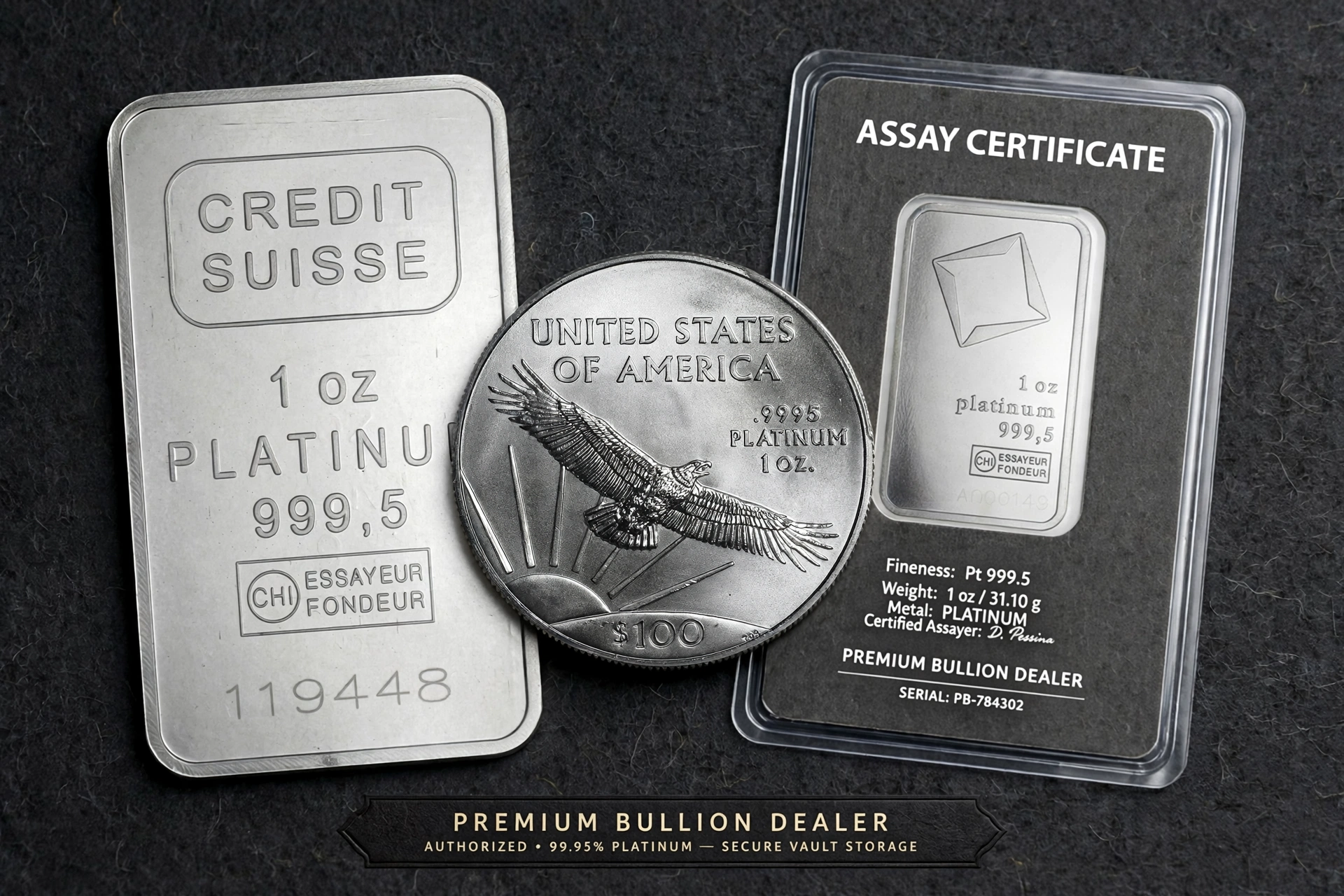
- American Platinum Eagle — the U.S. Mint’s platinum coin, first issued in 1997 and the first platinum coin in U.S. history. It contains 1 troy ounce of .9995 fine platinum, carries a $100 face value (the highest denomination ever placed on a U.S. coin), and shows John Mercanti’s Statue of Liberty on the obverse with Thomas D. Rogers’ soaring eagle on the reverse. Fractional sizes (1/2, 1/4, 1/10 oz) were struck from 1997 to 2008; today the Mint issues the 1 oz coin. Its weight, content, and purity are guaranteed by the U.S. government.
- Canadian Platinum Maple Leaf — the Royal Canadian Mint’s .9995 fine platinum coin, the other major government option. We do not currently stock it, but it is the coin most dealers will offer alongside the Eagle.
Platinum bars come from accredited private refiners — PAMP Suisse, Valcambi, Engelhard, Johnson Matthey, Credit Suisse. A minted bar (like PAMP’s Lady Fortuna) is struck with a design and sealed in an assay card; a cast bar is simpler and cheaper. Either way, the bar is .9995 fine, serial-numbered, and recognized by dealers worldwide.
Proof and collector coins are a third category: limited-mintage pieces like China’s lunar platinum coins, struck in proof finish with colorized designs. They carry a collector premium on top of the metal value and are bought for scarcity and design, not for the lowest cost per ounce. Treat them as collectibles, not as bullion.
For a first purchase, the practical choice is a 1 oz bar or a 1 oz Eagle. Bars cost less per ounce; the Eagle is easier to resell. The same logic applies to gold bars vs gold coins — the trade-off is identical, the market is just smaller.
What Platinum Actually Costs: Live Prices and Premiums
Premiums are measured against the platinum spot price — the wholesale benchmark set by the LBMA Platinum Price, fixed twice a day in London (9:45 AM and 2:00 PM). Here is what our own shop charged on November 15, 2026, against a spot price of $1,488.80 per ounce (GoldPrice.com, 8:31 AM ET):
| Product | Live price (Nov 15, 2026) | Premium over spot |
|---|---|---|
| 1 oz Engelhard Platinum Bar | $1,745.00 | $256.20 → 17.2% |
| 1 oz Lady Fortuna Platinum Bar (PAMP Suisse) | $1,742.00 | $253.20 → 17.0% |
| 2021 1 oz American Platinum Eagle BU | $1,750.00 | $261.20 → 17.5% |
| 10 oz Platinum Bar, .999+ fine (secondary market) | $17,300.00 ($1,730/oz) | $241.20/oz → 16.2% |
| 2024 China Dragon 15 g Platinum Proof Coin, colorized | $822.00 (15 g = 0.482 oz) | $103.95 → 14.5% (collector premium) |
Three things to notice. First, the 1 oz products cluster tightly: $1,742–$1,750, within $8 of each other. The Eagle costs the most (government guarantee), the Lady Fortuna the least of the 1 oz pieces (minted bar, no government premium). Second, the 10 oz bar is the cheapest per ounce at $1,730 — the same bulk discount you see with gold and silver. Third, the China Dragon proof coin’s premium looks low for a proof piece, but proof pricing follows collector demand, not a formula — buy it for the design and scarcity, not as a value play.
For context on where platinum sits against gold: gold spot on the same day was $3,883.45 an ounce. Platinum at $1,488.80 is roughly 38% of gold’s price — a $2,395 discount per ounce. Platinum’s 52-week range runs from $1,417.80 to $2,811.00, with the all-time high of $2,811 set in January 2026. The metal has fallen sharply from that high, which brings us to the premium question.
Why Platinum Premiums Are Wider Than Gold’s
A 1 oz gold coin typically costs 3–8% over spot. A 1 oz platinum coin costs 16–18%. The gap is real, and it has four causes:
1. The market is much smaller. Annual platinum mine supply is about 190 tonnes versus 3,000 for gold. Fewer ounces are minted, fewer dealers stock them, and the fixed costs of minting, distribution, and inventory are spread over far fewer units. A dealer holding platinum inventory carries more risk per ounce than one holding gold.
2. Lower mint volumes. The U.S. Mint strikes millions of Gold Eagles a year; Platinum Eagle mintages are a fraction of that. Small production runs mean higher per-unit minting costs, and that cost lands in the premium.
3. Thinner resale demand. A dealer buying back a Gold Eagle knows they can resell it tomorrow. A dealer buying back a platinum bar is less certain. The wider buy-sell spread is the dealer’s compensation for that uncertainty — and it shows up as a higher premium when you buy and a lower price when you sell.
4. Spot has fallen fast, and dealer prices lag. Platinum hit $2,811 in January 2026 and has fallen to about $1,489 — a 47% drop in ten months. Dealer shelf prices adjust with a lag, especially downward, so premiums look wide right after a sharp fall. It is a market-wide pattern, not a platinum-specific one: the same lag shows up in silver after a sharp spot drop. If platinum spot stabilizes, premiums should compress toward the 5–15% range that dealer price guides typically quote for 1 oz platinum coins.
The practical rule: always compute the premium from today’s spot price, and compare the same product across two or three dealers. A 17% premium on a Platinum Eagle is high by historical standards but normal for today’s market; a 30% premium would be a reason to shop elsewhere.
The Industrial-Demand Angle: Why Platinum Is Not Just a Precious Metal
Gold’s price is driven mostly by investors and central banks. Platinum’s price is driven mostly by industry — and that changes how you should think about it.
Autocatalysts are the biggest single use. About 40% of platinum demand goes into catalytic converters, mostly for diesel vehicles, where platinum cleans exhaust gases. That makes platinum sensitive to car production, emissions standards, and the shift to electric vehicles — which need no catalytic converter at all. The risk is real and structural: every electric vehicle sold is one fewer catalytic converter.
But the substitution story cuts the other way. Because platinum has traded well below palladium since 2017, automakers have been substituting platinum for palladium in gasoline catalytic converters — platinum-for-palladium substitution reached about 700,000 ounces in 2024, and the World Platinum Investment Council expects it to stay embedded in automotive demand, since substitution is locked in for a vehicle’s roughly seven-year platform life once it happens. That substitution is a genuine source of new platinum demand that did not exist a decade ago.
Jewelry is the second pillar. Platinum jewelry — especially in China and Japan — takes a large share of demand every year, and it is the most price-sensitive segment: when platinum is cheap relative to gold, jewelry demand rises.
The market has been in deficit. WPIC research puts the platinum market in consecutive deficits from 2023, driven by contracting South African mine supply and weak recycling. A deficit does not guarantee a higher price — demand can fall too — but it means the market is not oversupplied, which is more than can be said for many commodities.
Hydrogen is the long-term wildcard. Platinum catalysts sit at the heart of hydrogen fuel cells and of the electrolyzers that split water into clean hydrogen. The hydrogen economy is small today and its growth is uncertain, but if it scales, it would be a new and large source of platinum demand. Do not buy platinum on the hydrogen story alone — but it is a real upside that gold and silver do not have.
The honest summary: platinum’s price depends on cars, jewelry, and mining supply in South Africa. If you are comfortable with that — and with the volatility it brings — platinum diversifies a gold-and-silver portfolio in a way neither metal can on its own. If you want a metal whose price is driven by investors, buy gold instead. Our platinum vs palladium comparison on Bullion Estate goes deeper on the white metals if you are weighing the two against each other.
Is Platinum IRA-Eligible?
Yes — provided it meets the IRS fineness standard. Under IRC §408(m), platinum (and palladium) held in a precious metals IRA must be at least .9995 fine. Every bullion product in the table above meets that standard: the Eagle, the Engelhard bar, the Lady Fortuna bar, and the 10 oz bar are all .9995 (or .999+ for the secondary-market 10 oz bar, which exceeds the threshold).
Two caveats. First, the China Dragon proof coin is .9995 fine, so it meets the purity test — but proof and collector coins are generally a poor fit for an IRA because their value includes a collector premium the IRS does not recognize, and many custodians will not accept them. Second, as with any IRA metal, the platinum must be held by an approved depository, never at home — home storage is a prohibited transaction under IRC §4975. Confirm the exact product with your custodian before you buy; the custodian, not the dealer, makes the final call.
Liquidity: The Honest Truth About Selling Platinum
This is the part of the platinum pitch that usually gets skipped, so here it is plainly: platinum is harder to sell than gold or silver.
- The American Platinum Eagle is the most liquid platinum product. Any major bullion dealer will buy one. It is still less liquid than a Gold Eagle — fewer buyers, and the buyback price sits closer to spot.
- Recognized bars (PAMP, Valcambi, Engelhard, Johnson Matthey) sell well to dealers, especially in sealed assay packaging. Break the seal and the dealer has to test the bar, which costs you money.
- Secondary-market bars sell at a discount to new bars, because the buyer cannot verify the original packaging. Our 10 oz secondary-market bar is cheaper to buy for exactly this reason — and will be cheaper to sell for the same reason.
- Proof and collector coins are the slowest to sell. The buyer pool is collectors, not dealers, and collector demand for a specific coin is unpredictable. Do not buy a proof coin expecting to flip it.
The practical consequence: buy platinum as a long-term holding, not as a trade. If you might need the money in six months, gold or silver is the better choice — their markets are deeper and their spreads are tighter. Platinum rewards patience and punishes haste.
Storage: Same Rules as Gold
Platinum storage follows the same rules as gold and silver: keep bars sealed in their assay cards, keep coins in capsules or tubes, store in a secure, dry place, and consider a bank safe deposit box or professional vault for larger holdings. Platinum does not tarnish, so it is easier to store than silver — but the packaging matters more, because a broken assay seal costs you resale value. Our guide to storing gold and silver safely covers the full storage question, including when a home safe stops being enough.
Red Flags When You Buy Platinum
Platinum’s thin market attracts more bad actors than gold’s. Watch for these:
- Prices far below everyone else. Nobody sells real platinum below spot. A “deal” 20% under the market is fake metal or a scam.
- No assay card, no serial number, no packaging. A loose platinum bar with no documentation is a testing bill waiting to happen — and many dealers will not buy it at all.
- “Rare” or “collectible” platinum pitched as an investment. Proof coins and limited editions carry collector premiums that may never come back. If you are buying for investment, buy bullion.
- A dealer who sells platinum but will not buy it back. Ask before you buy. A dealer who will not buy back their own product is telling you something about its liquidity.
- Pressure to wire money to a personal account. Legitimate dealers take bank wires to a business account, cards, or PayPal — never to an individual’s name.
- No phone number, no address, no reviews. The same checks apply as for any bullion purchase — our guide to spotting fake gold and silver covers verification in detail, and the same tests (weight, dimensions, magnet, dealer reputation) apply to platinum.
Who Should Buy Platinum — and Who Should Skip It
Buy platinum if:
- You already own gold and silver and want a third metal with a different demand story — industrial, not just monetary.
- You are buying for the long term (five years or more) and can accept wider spreads and slower resale.
- You believe the gold-platinum price gap will narrow, or that industrial demand (autocatalysts, hydrogen) will support the price.
- You are comfortable with volatility: platinum’s 52-week range this year runs from $1,418 to $2,811.
Skip it (or wait) if:
- This is your first precious metals purchase. Start with gold or silver — deeper markets, tighter spreads, easier resale.
- You might need the money soon. Platinum is the wrong metal for a short holding period.
- You want income or a hedge against a stock market crash specifically. Platinum correlates more with industrial demand than with financial panic.
Frequently Asked Questions
Is platinum a good investment?
Platinum is a legitimate diversifier with real industrial demand, a market in deficit, and a price well below gold — but it is more volatile and less liquid than gold or silver. It suits a long-term holding as part of a diversified metals portfolio, not as a first or only purchase.
Is platinum rarer than gold?
Yes. Platinum is roughly thirty times rarer than gold in the earth’s crust, and annual mine production is about 190 tonnes versus roughly 3,000 tonnes of gold. Rarity alone does not set the price — demand does — which is why platinum trades below gold despite being rarer.
Is platinum better than gold?
Neither is automatically better. Gold is more liquid, less volatile, and driven by investors and central banks. Platinum is rarer, cheaper per ounce, and driven by industrial demand — which gives it different risks and different upside. Most buyers who own both hold far more gold than platinum.
How much does it cost to buy platinum?
As of November 15, 2026, platinum spot is about $1,489 an ounce, and a 1 oz bar or coin costs roughly $1,742–$1,750 — a premium of about 16–18% over spot. A 10 oz bar costs about $1,730 an ounce. Always compute the premium from the live spot price on the day you buy.
Is platinum IRA-eligible?
Yes, at .9995 fineness or higher, under IRC §408(m). The American Platinum Eagle and bars from accredited refiners (PAMP, Valcambi, Engelhard) all qualify. The metal must be held at an approved depository, never at home. Confirm the exact product with your custodian before buying.
Next step: Start with the most liquid platinum there is — a 1 oz American Platinum Eagle or a 1 oz Engelhard Platinum Bar — then add a 10 oz platinum bar when your budget allows. If you are still deciding between the white metals, read platinum vs palladium: which metal should you buy? first.
This article is for education only and is not financial or tax advice. Platinum prices are volatile and the market is thinner than gold or silver — confirm the live spot price and the dealer’s buyback policy before you buy.